Mostrando entradas con la etiqueta higgs. Mostrar todas las entradas

sábado, 14 de febrero de 2015

La Gran Depresión en USA: El cataclísmo, 1930-33

Fuente

La Gran Depresión en Estados Unidos es uno de esos sucesos que son sacados de la manga en cualquier debate para "demostrar" que el capitalismo lleva inevitablemente a una crisis catastrófica debido a sus supuestos excesos y contradicciones. Se suele creer que en 1929 la especulación desenfrenada de los años previos, hecha posible porque el Estado no regulaba las acciones de la gente, provocó un crisis en la bolsa de valores que desencadenó una depresión. El Presidente Republicano de Estados Unidos, Herbert C. Hoover (1929-1932), no intervino en la economía y dejó al mercado libre para hacer los ajustes. Como consecuencia de ello, tuvimos la mayor depresión económica mundialmente conocida.

El problema de ese relato es que es completamente falso de principio a fin. Los hechos son increíblemente diferentes a lo que nos cuentan los libros de historia de la escuela.

La cronología de sucesos a partir de 1930 en Estados Unidos es la siguiente (Higgs, 1997):

1930-1940: La Gran Depresión.

1940-1941: La transición a la economía de guerra.

1942-1945: La economía comandada de guerra.

1945-1946: La desmovilización.

1946 en adelante: La prosperidad post-guerra.

A su vez, la Gran Depresión se puede dividir en 3 etapas: 

1) Lo que podemos denominar "el cataclismo" (a veces llamado, discutiblemente (Salerno, 2012), "contracción secundaria" o "deflación secundaria") que va desde 1930 hasta 1933. 

2) La segunda parte que se puede denominar la "recuperación inusualmente lenta de la inversión" desde 1934 a 1937.

3) Y finamente la "recesión dentro de la depresión" de 1937-1938.

Lo que da el adjetivo de "Gran" a la depresión de los años 30s es a) la profundidad y magnitud de la caída en los primeros años y b) la duración de la mala situación posteriormente, que empeoró con la recesión de 1937-38.

La parte esencial a explicar y la que veremos, muy superficialmente, desde el punto de vista austriaco en próximos posts, es el cataclismo. ¿Cómo es posible una contracción tan profunda por tantos años consecutivos? Caer todo 1930, todo 1931, todo 1932 y gran parte de 1933 es, en términos históricos, demasiado tiempo para descender. En especial para una economía desarrollada. Veamos solo algunas cifras para comprender la magnitud de la catástrofe en el país del norte.


El PBI real en dólares de 2009 se desploma un enorme 8,5 % en 1930. Un menor 6,4 % en 1931. Brutalmente casi 13 % en 1932. Y finalmente un relativamente bajo 1,3 % en 1933. Aun siendo mínima, esa baja de 1933 se produce cuando la economía ya estaba en el subsuelo, por eso es que es tan mala. Tomando 1929 y 1933, el PBI real cae un 26 %.


El PBI per cápita (linea roja, eje derecho) se comporta peor aún. Entre 1929 y 1933 el PBI per cápita cae a la mitad.


La inversión bruta interna privada se destruye completamente hasta quedar solo prácticamente una décima parte de lo que era en 1929.


La producción industrial colapsa entre 1929 y 1932 cayendo un 46 %.


Finalmente la serie clásica de Lebergott de tasa anual de desempleo sube constantemente hasta 25 % en 1933.

Lo esencial es notar que la economía colapsa todo el periodo 1930-1933. La causa del desastre, veremos, está lejos de ser atribuible al capitalismo.


Higgs, Robert (1997), "Regime Uncertainty: Why the Great Depression Lasted So Long and Why Prosperity Resumed after the War". The Independent Review: A Journal of Political Economy. Vol. 1, No. 4, 561-90. En Higgs, Robert (2006), Depression, War, and Cold War: Studies in Political Economy. New York: Oxford University Press, Inc. 3-29.

Salerno, Joseph T. (2012) "A Reformulation of Austrian Business Cycle Theory in Light of the Financial Crisis". Quarterly Journal of Austrian Economics. Vol. 15, No. 1, 3-44.

domingo, 25 de agosto de 2013

No, The War Was Not Good


"Lord Keynes" (LK) has two posts, and some others, trying to show something good on World War II. I must say however that I found his attempt highly unconvincing. I will try to show it next.


1)  LK says:
"The sheer absurdity of asserting that “no economic good” of any kind came out of the war is refuted by this point alone. Many people no longer had to experience the grinding poverty of unemployment, and obtained work on the home front when the war started. And they obviously chose that work over being unemployed."
His “one-point refutation” is only valid in the case that there was no other alternative to give jobs to unemployed people than war. But that was not true. 

It is very easy to end unemployment trough all kinds of wasteful projects. Hitler’s military command economy also put an end to German unemployment, even a useless mediocre like Stalin could achieve some kind of "full employment". Can anyone deny the "employment effects" of building big concentration camps? No. But everyone can agree that, in a non-intervened price system, there were other alternative uses to employ those resources. So it is totally wrong to say that "at least" concentration camps "create employment". Concentration camps were just one (very unprofitable and unfeasible in market) project, which to be achieved must employ resources, but there were a lot other profitable projects for those resources in a non-hampered market.  We can apply the same thing to war. 

There is a fact that cannot be denied: Employment to produce things to destroy is very different than employment to produce things to consumers. In both ways you can employ people, but the costs of those employments are different in each situation. People's standard of living will vary in both cases. You can have either a) employment and increasing standards of living or b) employment and lowering and bad standards of living. LK finds some "good" thing in b) only by looking at employment. But b) not only is an inefficient way, it is totally unsustainable because you cannot maintain the destroying policy after everything and every incentive to create have been destroyed. However a) has both qualities: a tendency to efficiency and it is sustainable. 

The “benefit” of employment of the former unemployed people was achieved by creating a loss to those killed/injured or to capital goods and then lowering others' standard of living, not to mention that this kind of employment involves a high risk job for those "employed" in battlefield. You are employing resources to destroy other resources (people killed/injured at front are labor resources lost). But lets assume that bullets, tanks, guns, etc. are produced but no one uses them, so no one is killed. Even here we have a zero-sum game. Resources that could have been devoted to satisfy consumers have been wasted on useless armament, so the “profit” of the jobs created was achieved by the loss of standard of living of everyone (included those employed in armament). In short: There are people employed but there is no enough bread. There is no economic good on all this. 

If a big confrontation were a good remedy for unemployment, we could have obtained a similar result just by hiring unemployed Americans to kill other Americans. Can we deny the employment effects of this? Notice how arbitrary are the possibilities when government "hire" people to do whatever we want if we consider employment as an end, instead of a means to achieve ends. Free-market economists know that work is a means to achieve ends, not an end in itself. If creating jobs is the end, then any end that uses workers is valid, so LK will have to face the reality of admitting that building concentration camps were a good way to create employment. A Hitler's admirer can say that people preferred to work on building gas chambers for Jews rather than "starve in unemployment", and LK will have to accept that statement. 

The only possible answer I think LK can use, is that he is defending a particular end: War against Nazism. However this does not solve the problem, because that is just an arbitrary end. In exactly the same way, Hitler could have said that he was fighting against "malign capitalist exploiter imperialism" and "barbaric communist materialism". As well as Bush could justify his war by saying he was "fighting terrorism" and "avoiding" further attacks on American soil. Since communism and terrorism are as bad as fascism, those wars were justified under LK's criterion. This is not of course a defense of Hitler; it is a criticism of LK's method to justify war: his arbitrariness. Despite the fact that Hitler's was a terrible genocidal totalitarian regime and we can certainly make a case to war him, today there are other bad regimes similar to fascism (North Korea can menace the entire world with nuclear weapons).

It was perfectly possible to "combat" unemployment without destroying resources, without lowering everyone's standard of living, without rationing and putting price controls, without killing people, without destroying capital goods, etc. Had not the government intervened the economy, see Higgs (1997), and labor market, see Gallaway and Vedder (1987), US could have reached the employment of people without the destruction event of war. So there was no merit at all on employing people for war if we compare it with the other possible peaceful market solution.

In focusing in the benefits of one group (those former unemployed now employed) LK is not seeing the group that is victimized and resources lost (those American soldiers killed i.e. less labor, those people forced to reduce their standard of living, those who suffered rationing, inefficient price controls, goods that didn't come to exist because resources are being used to fight war, etc.). It is true that, as Higgs said, some few people benefited from price control. That is the basic fact of a shortage created by maximum price! Some few people will get the product at the artificially lowered price, but there will be a great majority of people that will not. You had, say, 300 people that could buy the milk and 100.000 people that couldn’t. Only by omitting all this (“what is not seen”), one can say that there was something "good" in WWII.

To the extent that war means to deliberately lose real (workers on the front, capital goods, investing iron in tanks instead of cars, etc.) and monetary resources, it does not contribute one iota to prosperity. By concentrating just on employment as the thing “positive” of war, LK has overlooked what was destroyed by that employment and the alternative market method to achieve employment. That destruction, makes his only positive point useless.

There was an alternative way to employ people which could have achieved both 1) not letting the people starve by allowing them to work and at the same time 2) it wouldn't had destroyed wellbeing of every one.  

WWII did lower American's standard of living, as Horwitz and McPhillips (2013) demonstrated, not only from the statistic point of view. Average American did not even think that their standard of living was recovering in those years.

Higgs (1992) also knew it: 
“the deterioration of quality and disappearance from the market of many consumer goods, the full effect of the nonprice rationing of many widely consumed items, and the additional transactions costs borne and other sacrifices made by consumers to get the goods that were available. When one corrects the data to provide a more defensible measure of what happened to real consumer well-being during the war, one finds that it declined… one must recognize that consumers had to contend with other extraordinary welfare-diminishing changes during the war. To get the available goods, millions of people had to move, many of them long distances, to centers of war production… After bearing substantial costs of relocation, the migrants often found themselves crowded into poorer housing. Because of the disincentives created by rent controls, the housing got worse each ear, as landlords reduced or eliminated maintenance and repairs. Transportation, even commuting to work, became difficult for many workers.”
In another place he wrote: 
"Unemployment fell during the war entirely because of the buildup of the armed forces. In 1940, some 4.62 million persons were actually unemployed (the official count of 7.45 million included 2.83 million employed on various government work projects). During the war, the government, by conscription for the most part, drew some 16 million persons into the armed forces at some time; the active-duty force in mid-1945 numbered in excess of 12 million. Voila, civilian unemployment nearly disappeared. But herding the equivalent of 22 percent of the prewar labor force into the armed forces (to eliminate 9.5 percent unemployment) scarcely produced what we are properly entitled to call prosperity."
Higgs  (2004):
"If we take into account only those parts of the wartime capital formation that had value beyond their sheer immediate usefulness in winning the war, and if we give appropriate weight to the significant measurement errors that I have described, then we may conclude with reasonable confidence that, in fact, real capital formation during the first half of the 1940s was not proportionally greater than that during the latter half of the decade; indeed, it was more likely a good deal less. The wartime socialization of investment served a definite purpose in allowing the U.S. military-industrial complex to triumph over the nation’s enemies in World War II. Beyond that, its achievements had little if anything to recommend them."
And also Skousen (1988): 
“Certainly, millions of idle workers were put back to work, but hundreds of thousands died or were wounded on the battlefield. Employment during the war was not particularly easy. The average work week rose 20 percent in manufacturing, construction, and mining, and many key employees, especially engineers, had to work weary 14-hour days, 7 days a week. Taxes increase dramatically and permanently. The standard of living declined during this time, despite higher incomes, as Americans gave up many of the pleasures of life.” 
Even the "orthodox" story demonstrates how restricted and bad the situation of people was. After war they spent their savings on goods that they couldn't get before due to command economy, thus creating a "consumption boom". Higgs (1999a) defies this story, people reduced their real saving rate but they did not dissave. 

It is true that LK recognizes that the people situation’s at war jobs was not good, but his justification is that a bad job is better than no job, ignoring the alternative way to employ people and other costs. 

Real consumption, real private investment (at 55% of its 1941 level) and private output (it was below 1933!) sunk in war years, Murphy (2012). That was certainly not an improvement on standard of living. And remember that millions of people died in war. Putting aside any moral and ethical consideration, that meant a real resource lost because there were less young, productive and healthy workers.

Even Krugman knew that people were living badly: 
"Consumer goods were rationed; people were urged to restrain their spending to make resources available for the war effort."
Yet another cost of war was the massive increase in power of government and decrease civil liberties. Again here is Higgs (1999b)
“World War II witnessed massive violations of human rights in the United States, apart from the involuntary servitude of the military conscripts. Most egregiously, about 112,000 blameless persons of Japanese ancestry, most of them U.S. citizens, were uprooted from their homes and confined in concentration camps without due process of law.” In his obsesion with employment Lk overlooked all this costs. Which is very strange for someone who aparently is social democrat, because these costs are always taken in full account by all members of that left oriented ideology. This are economic issues to the extent that are interventionist meassures."
Not even LK's “advance in technology” favorable argument is true. Actually Mises had answered (Lecture 6 and Human Action) a very similar argument, however it was not about war but about credit expansion.  

If some technological innovation is unprofitable right now, it is because people have more urgent needs right now! At the moment of war people needed other goods or services rather than using resources to develop computer or rocket technology. So that acceleration in technology advance cost satisfactions that were more valued by people. It is not true that that was a improvement. If people were not willing to pay for that technology (either because it was too expense or because it was not discovered a profitable peaceful use yet) on that moment that means that develop that technology on that moment was a wasteful of resources. Let’s see an example to see how bad can be to force acceleration of events. 

You can force your son to work hard and save since he is 10 years old in order for him to purchase his own house in some years. I am sure that he would highly prefer to play and make friends like other kids, but you have “command and control” over him. After some years, maybe at the age of 25, the boy would have paid the full value of a house and LK could say “look! Thanks to command and control of his life, the boy had earned a home at his 25. That is a clear advance over other kids of his same age”. However, in forcing him to work since he was a kid, you have made him waste his childhood in working, and surely he would have preferred to have good friends and play a lot more rather than work. You cannot say that it was a "clear advance" to force him to work since his 10 until his 25 so he has full property of a house. As in Mises' railroad example, the boy could have owned the house 20 years later (at his 45) without squandered his childhood, but because of command and control of his father he had the “crisis” and trauma of not having had a good childhood. Even if the kid had his own house, we cannot say his father improved his life through forcing him to get his home sooner. In the same way we cannot say that "forced" acceleration in technology advance in WWII has necessarily “improved” American's life, because we would be forgetting all the things consumers could not afford in order to develop by force the technology on war years.

War costs manpower, the lose of capital goods and other real resources, reduction in standard of living, freedoms of people and is a very risky adventure. Computers, radar, nuclear power, rockets and internet would have existed with or without war. The only possible “merit” of war, was accelerating by force its appearance. However the costs of that acceleration were far greater than benefits of having them at an earlier date. What is seen is the computer, rockets, jet, etc. that maybe would not have been developed so soon, LK completly fails to notice what is not seen. So LK cannot affirm that that was an “improvement”. This is not a moralistic critique; costs by far surpassed benefits from people’s and economic point of view. Maybe from political and military point of view war was a "success", but not from society's. Notice that I’m not saying that LK advocates war, what I am saying is that the things that he considers “good” about it, had a lot of higher unseen costs, so they cannot be seen as a net good result. 

And about his assertion that there were a lot of malinvestments after war, yes there were. However "Lord Keynes" must know that, from Austrian point of view, produced capital goods have different degree of convertibility. Some capital goods can be saved from government’s made disaster by entrepreneurs. One example is Aristotle Onassis. When war ended and there were a lot of useless Liberty ships, he had the entrepreneurial ability to anticipate a future increase in naval commerce and bought some of those ships. Because of that, he made great part of his fortune. And again it must be remembered that when we talk about past malinvestments, savings also helped! Far from “refute” Austrian theory, this only reinforce the Austrian story. 

In short. All Austrians know very well that any amount unemployment can be easily removed by government just by building a lot of pyramids. What they also know is that 1) It is unnecessary, because employment could have also been achieved by non-intervened wages (this does not mean "lowering ALL wages" like some ignorants think) 2) Totally inefficient, as the lowering in standard of living of Americans in WWII demonstrated 3) Unsustainable. 

One last thing about unemployment numbers of the Great Depression. Darby's method was completely refuted by Kesselman and Savin (1978) and severely criticized by Gordon (1976). So there is no discussion on unemployment figures here because Darby completely failed.

2) LK continues:
"Secondly, the war allowed the accumulation of savings and money income. The point overlooked by Higgs is that this also allowed both business and consumers to finally complete the process of deleveraging and paying down private debt to a low level. That is a fundamental point: the debt deflationary drag on the US economy was eliminated during the war, as we can see in this graph (in the “private debt” line)."
Austrians before that paper of Higgs knew very well the role of that particular kind of “forced saving” during war. Actually that was in full conformance with Austrian theory, as Skousen (1988) said:
"[I] suggest that the World War II economic boom was in large part the result of a third major factor, often ignored by most economists. This factor is the unprecedented rise in personal and business saving rates during 1941-45. The spectacular rise in private savings provided the billions of dollars necessary to support the war,… Although several variables (including government spending, monetary inflation, and tax rates) changed during World War II, it is remarkable how economic trends followed this Austrian scenario… According to Austrian theory, increased savings and lower interest rates will, other things being equal, precipitate an expansion of raw commodities and capital-intensive industries."
What Austrians also knew, was that 1946 was not thanks to Keynesianism, Vedder and Gallaway (1991): 
“In short, rather than "pent-up demand" preventing a depression, the evidence is more consistent with a distinctly non-Keynesian interpretation: A downward adjustment in labor supply and real wages, accompanied by a more responsible (non-deficit) fiscal policy, served to stimulate investment and consumption spending. Relative price adjustments brought about what Keyensians perceived to be an increase in aggregate demand, rather than the other way around… The evidence shows that aggregate demand rose too little and too late to explain the low unemployment that prevailed in the first two years after V-J day, the period in which demobilization was completed. What did happen was that labor markets, partially con- strained by non-price factors in the wartime period, were allowed to function in a manner that prevented a serious decline. Labor supply abruptly fell, but in addition real wages, adjusted for productivity change, also fell, preventing a massive rise in unemployment. ”
I think that it's unnecessary to say that Austrians also know very well that deleveraging is good for economy.

 3)  LK then says:
"Thirdly, the war fundamentally shifted business expectations from being highly pessimistic to a strong optimism that emerged after the conflict ended."
As explained before, ("forced") savings played a big role. But if LK thinks that “optimistic” expectations helped to revive private investment, then he must accept Higgs’ regime uncertainty explanation on how businessmen's expectations were crushed by Roosevelt's interventionism. 

Finally let’s be fair. I have seen LK in comment sections of a lot of blogs and I am reading some of his own posts. LK accuses others on “citing ad nauseam” Higgs, and maybe he is right. However by using his own criterion for example I can accuse him of citing ad nauseam Sraffa on every single discussion about ABCT in every place. 

Conclusion    

It is true that WWII lowered enormously unemployment and created a boom, nobody has ever denied that. However it is not true that this was a “good” thing about war, if we take in account that there was an alternative better method to employ people. And that alternative method was by far more efficient and sustainable than war.  Besides there were a lot of costs that are not taken into account when we talk about the "benefits" of war.

There was nothing we can call "good" about WWII. The only good war was this one...


Bibliography

Gallaway, Lowell and Vedder, Richard K. (1987) "Wages, Prices, and Employment: Von Mises and the Progressives". Journal: The Review of Austrian Economics, Vol. 1, No. 1.

Gallaway, Lowell and Vedder, Richard K. (1991) “The Great Depression of 1946”. Journal: The Review of Austrian Economics, Vol. 5, No. 2.

Gordon, Robert J. (1976) "Recent developments in the theory of inflation and unemployment". Journal: Journal of Monetary Economics, Vol. 2, No. 2. Northwestern University, Evanston, IL , U.S.A.

Higgs, Robert. (1992) "Wartime Prosperity? A Reassessment of the U.S. Economy in the 1940s". Journal: The Journal of Economic History.

Higgs, Robert. (1997) "Regime Uncertainty: Why the Great Depression Lasted So Long and Why Prosperity Resumed after the War". Journal: The Independent Review, Vol. 1, No. 4.

Higgs, Robert. (1999a) "From Central Planning to the Market: The American Transition, 1945-1947". Journal: The Journal of Economic History, Vol. 59, No. 3. Cambridge University Press.  

Higgs, Robert. (1999b) "How War Amplified Federal Power in the Twentieth Century". The Freeman.

Higgs, Robert. (2004) “Wartime Socialization of Investment: A Reassessment of U.S. Capital Formation in the 1940s”. Journal: The Journal of Economic History, Vol. 64, No. 02.

Horwitz, Steven and McPhillips, Michael J. (2013) “The Reality of the Wartime Economy: More Historical Evidence on Whether World War II Ended the Great Depression”. Journal: The Independent Review, Vol. 17, No. 3.

Kesselman, Jonathan R. and Savin, Eugene N. (1978) "Three-and-a-Half Million Workers Never Were Lost." Journal: Economic Inquiry 16. Oxford University Press, UK. 

Murphy, Robert P. (2012) "The Myth of Wartime Prosperity". The American Conservative.

Skousen, Mark. (1988) “Saving the Depression: A New Look at World War II”. Journal: The Review of Austrian Economics, Vol. 2, No. 1.

domingo, 2 de junio de 2013

La Mentira del $hock


Hace años vi el trabajo de Naomi Klein llamado La Doctrina del Shock. Cuando lo vi esa vez no pude creer la cantidad de mentiras y falsos datos que había en el. Pues hoy decidí hacer un post para refutar y enterrar totalmente este (pseudo)documental. Esto es aplicable solo al video linkeado, no a lo que dice el libro. Si perdí 78 minutos de mi vida viendo esta cosa, y otros 78 minutos volviéndola a ver para hacer este post, no perderé más tiempo valioso leyendo el libro en el que se basó. Si el documental es malo, no quiero imaginar lo que será el libro. Además deseo aclarar que muy lejos estoy de tratar de defender a Milton Friedman, un estatista que ayudó diseñar el sistema impositivo que hizo que el estado pudiera crecer enormemente (pag. 387). No debería extrañar a nadie que los verdaderos liberales lo hayan llamado un socialista. Pues he aquí las 10 mentiras de Naomi Klein:

1) La tesis central y todo en lo que basa el documental son dos cosas: a) Todo lo malo en el mundo es culpa de Milton Friedman (está bien es una exageración, pero más o menos esa es la idea), pero el punto más importante es b) Las crisis, que son provocadas por malvados neoliberales, son oportunidades para "reducir el estado" y "extender la libertad económica". Es decir que cada vez que hay un crisis el estado retrocede más (en especial desde los 80's).

Lo primero que se me vino a la cabeza cuando vi esto, fue Robert Higgs. Mucho antes de que Klein siquiera pensara sobre este tema, ya estaba refutada. Higgs en 1985 (cuando Naomi con 15 años bailaba con sus amigas y compraba en shoppings) y luego en 1987, usando datos empíricos y haciendo algo que llamamos Ciencia de la Historia (eso que Naomi desconoce!), demostró que cada vez que hubo una crisis que significó un incremento de gasto público, este no volvió a sus niveles previos a la misma. A esto lo llamó Ratchet Effect (efecto trinquete). Es decir que el tamaño, alcance y poder del gobierno crece abruptamente durante una crisis ("shock") debido a los pedidos de que "hay que hacer algo", cuando la amenaza fue eliminada o disminuida el mismo vuelve a decrecer. Pero el tamaño del gobierno no vuelve al nivel que hubiera llegado si la crisis no hubiera ocurrido y menos aún vuelve al nivel previo a la crisis. Las crisis no solo crean grandes aumentos temporales de gobierno, sino también crean un gobierno más grande permanentemente. La crisis o "shock" cambia la trayectoria de crecimiento del tamaño, alcance y poder del gobierno a un nivel superior. En resumen las crisis o shocks aumentan el crecimiento del gobierno, no lo disminuyen.


El gráfico muestra en el eje vertical el logaritmo de un índice ideal del tamaño del gobierno y en el eje horizontal está el tiempo. Allí se puede ver el Ratchet Effect y tiene 5 etapas. La Etapa I es la fase normal previa a la crisis (la línea AB). La Etapa II es la expansión repentina por la crisis-"shock" (línea BC). La Etapa III es la madurez (línea CD), el máximo "combate" contra la crisis. La Etapa IV es la retirada una vez solucionada o disminuida la crisis (línea DE). Y la Etapa V es la normalidad post-crisis (línea EF) más elevada de lo que hubiera sido la trayectoria sin la crisis (línea ABE'F'). Veamos el gasto público como porcentaje del PBI americano (un buen indicador del tamaño del gobierno).


Matthew Mitchell explica el Ratchet Effect con este gráfico: 


Yo mismo hice mi propio gráfico. Me metí a este sitio y busque: Gasto Público Total (tabla 3.1, línea 15), gasto en Defensa (tabla 3.9.5, línea 11) y gasto Social (tabla 3.12, línea 3. Es solo el gasto federal, fui "bueno" y no puse los beneficios sociales que harian que esa linea sea aún más alta). Todo esto lo dividimos en el PBI americano (tabla 1.1.5, línea 1) y obtenemos el porcentaje de PBI.


Para ver mejor tuve que "cortar" el tremendo gasto de la Segunda Guerra Mundial que llego a casi el 45%. Viendo los datos, desafío a cualquiera a que demuestre en que momento el gasto público ha tenido una tendencia sostenible de decrecimiento. Pero además de ver como el tamaño del gobierno (línea azul) lejos de disminuir ha aumentado, también se ve que el gasto social (línea verde) ha aumentado constante y enormemente. Donde está el estado neoliberal "despreocupado por los pobres"? De más está decir como ha disminuido el gasto en defensa (línea roja). A pesar de todos los "shocks", todo el "neoliberalismo" y toda la sanata de "shocks de guerra" estilo Klein, el gasto en defensa cayó. Déjenme repetirlo por si no queda claro: A pesar de los "shocks", a pesar de Friedman, a pesar de Reagan-Thatcher-Bush(hijo y padre), en USA el tamaño del gobierno ha aumentado, no ha disminuido, repito: NO ha disminuido!!! NO!  

Pero veamos ahora el caso argento:


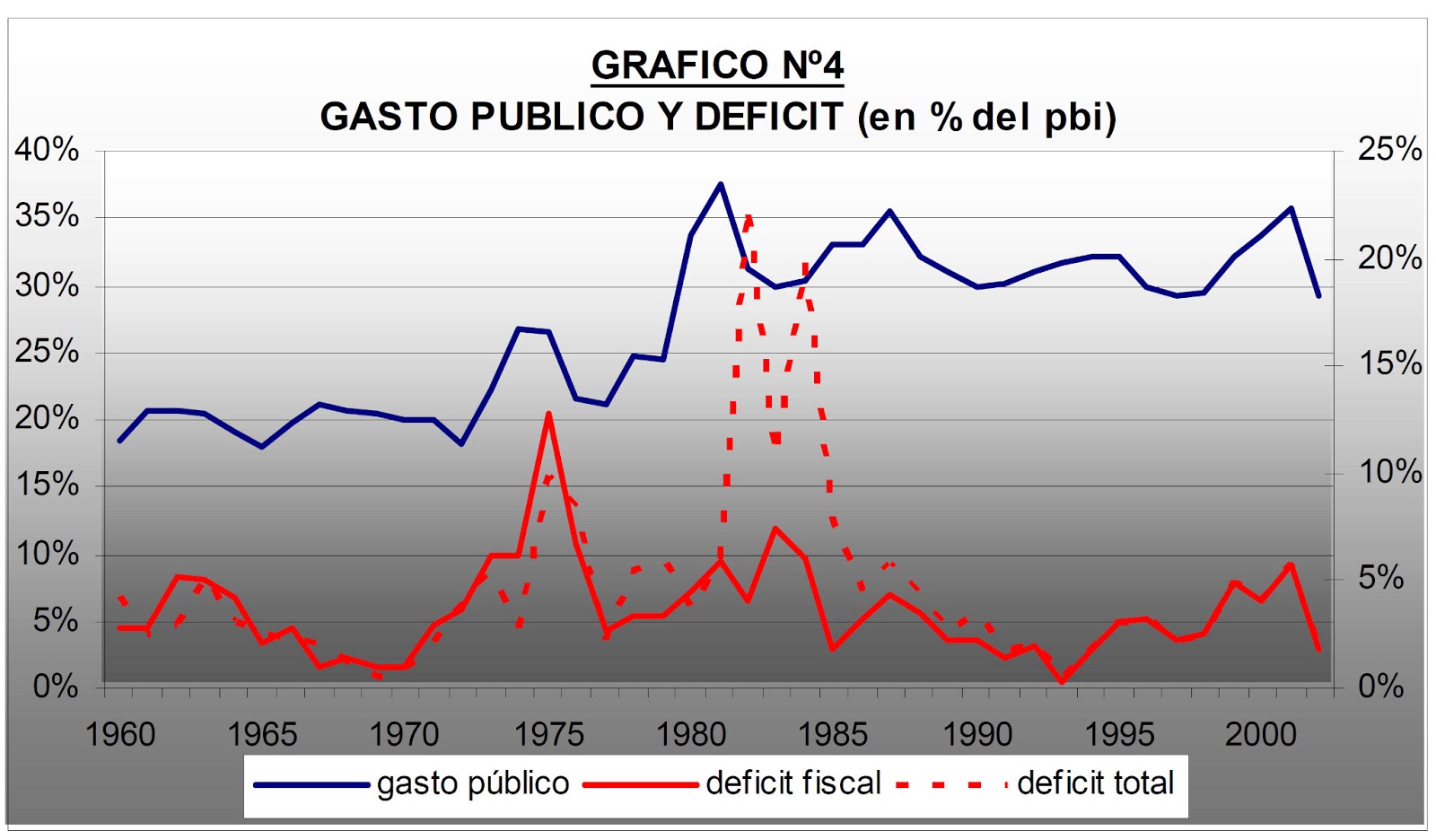
Como se ve en los graficos, el gasto público argentino como porcentaje del PBI (línea azul) tiene un comportamiento similar, en ningun momento se ve una tendencia sustentable de decrecimiento. Lo contrario es la verdad: El gasto publico/PBI (el tamaño del gobierno) no ha parado de crecer. De hecho es precisamente durante el gobierno militar que se da el cambio de trayectoria que aumentó el tamaño del gobierno de manera permanente!!! (chupate esa mandarina Naomi Klein). Incluso el gasto social no solo muestra el comportamiento Ratchet sino tambien se ve que no paró de crecer.

Habiendo destruido totalmente el punto central de este "documental", se demuestra que básicamente es basura. Esta basado en una falacia refutada antes de ser creada. Los shocks lejos de disminuir el estado, lo aumentan de manera permanente. Por lo que solo nos quedan 9 puntos accesorios más que demostraran no solo que el documental es una falacia irreal, sino que Naomi Klein miente deliberadamente varias veces.

2) Antes de terminar los primero 10 minutos ya hay datos falsos: La economía americana no salió de la Gran Depresión gracias a la Segunda Guerra Mundial, ese mito fue destruido por, de nuevo, Robert Higgs hace años.  Y tampoco salió gracias al New Deal, eso solo prolongó la duracion de la Gran Depresion. Acá se demuestran las cosas con evidencias fácticas, no con "cuentos de Hadas".

3) Klein dice que Friedman "lucho una guerra contra el New Deal". Totalmente falso. Friedman en persona dijo que "La otra parte de al política del New Deal era la de alivio y recuperación... las ayudas a los desempleados, darles puestos de trabajo y motivar que la economía se expanda... una política monetaria expansiva. Esas partes del New Deal yo las apoyé." El entrevistador asombrado, como yo lo estoy de que Naomi Klein de charlas en universidades, le pregunta a Friedman: "Por qué apoyo eso?" Y Milton contestó: "Porque era una circunstancia excepcional. Estábamos metidos en una situación extraordinariamente difícil, sin precedentes en la historia de la nación. Tenías millones de personas sin trabajo. Algo debía hacerse, era intolerable. Fue un caso en que, a diferencia de la mayoría de los otros casos, el corto plazo tenia que preponderar." Y aca esta la serie de Friedman donde dice: "La nueva administración Roosevelt... autorizó gastos masivos para proyectos del gobierno... desarrolló programas destinados a darles seguridad a todas las personas... aún cuando estas medidas hubieran sido útiles y realmente necesarias durante los años de la depresión, el extremo al que han sido llevadas desde entonces habría horrorizado a Keynes... [algunas de las ideas de Keynes] eran buenas para los años 30's, pero no eran buenas para una situación de post-guerra."  Donde está el Milton "no-intervencionista" dando batalla contra el New Deal? Si pensas que el ridículo que está haciendo Klein acaba acá, te equivocas.

4) Los socialistas siempre buscan un factor externo (“imperialista”, “capitalista”, “norteamericano”, “sionista”, etc.) para explicar el (predecible) fracaso de su propio sistema y de sus “buenas intenciones”. Klein, como era de esperar, recurre a los “argumentos” de esa patología: Según ella, Salvador Allende fracasó en Chile porque Nixon ordenó sabotear la economía en los 70’s. En ningún momento, ninguno!!! menciona siquiera que en Chile hubo una pequeñita cosita llamada hiperinflación. Su versión es tan ingenua que es sospechosa, dice algo así como "Llegó Allende, se hizo el socialista, en Washington se enojaron y mandaron a los militares a reemplazarlo. Fin." Sin embargo lo que realmente ocurrió fue de manual: Allende congelo los precios de los bienes básicos y ordeno aumentar los salarios, la inevitable escases por exceso de demanda monetaria y disminución de oferta de las empresas que se funden al aumentarles los costos y vender al mismo precio, no se hizo esperar. Adivinen que hizo Allende? Así es, adivinaste: culpó a la derecha, a los acaparadores, a los anti-revolucion, etc. A medida que se fundían, las empresas eran tomadas por el gobierno "en nombre del pueblo". Y como se financiaban las pérdidas? Imprimiendo dinero, que gran idea! La oferta monetaria pasó de 10.1 mil millones de escudos al final de 1970 a 20.5 en 1971, aumentó un 103% en solo un año! (anteriormente subió 65% en 1970 y 35% en 1969). Con los trabajadores llenos de dinero y sin bienes que comprar (lo que los socialistas llaman "Justicia Social"), el mercado negro (afortunadamente para ellos) apareció. Todo estaba relativamente bien mientras la economía sumergida aceptara escudos. Pero con la imprenta de dinero galopando, un día en 1972 dijeron "solo aceptamos dólares", y ese día llego la hiperinflación. Pero donde esta el malvado Nixon obligando a Allende a imprimir dinero? No es de extrañar que ese caos creado por Allende haya sido el caldo de cultivo y la excusa perfecta para un golpe de militares.

5) Luego de explorar el mito de que Pinochet era liberal, dice que vivimos en una época de "capitalismo desenfrenado"... Por supuesto eso es mentira. La economía americana por ejemplo desde los 70's nunca ha estado más regulada que hoy. Y en el resto del mundo el estado (gasto publico/PBI) no ha dejado de crecer en mayor o menor medida.

6) Necesariamente ligado a lo anterior, ella recurre al mito barato de que la dictadura argentina de 1976 tuvo "políticas de libre mercado"... Sí, claro. Si Aumentar el gasto público (%PBI), el gasto social (excepto en 1982 por la guerra, claro), no privatizar nada y nacionalizar empresas (Austral, Italo), financiar el aumento del gasto endeudandose, mantener el proteccionismo "liberalizando" muy pocos sectores, etc. es hacer políticas de libre mercado, entonces yo soy Messi... 

7) Una de las peores y menos certeras afirmaciones: "Friedrich von Hayek insto a Thatcher para que copiara la política económica de terapia de shock de Pinochet." Para acusar a uno de los mayores liberales del Siglo XX de algo así, uno se imagina que hay alguna prueba de ello. Acaso ella brinda alguna carta, memorándum, conferencia, discurso, entrevista, dialogo, algo!!! que pruebe ello? NO, nada, absolutamente nada, cero pruebas. Solo lo afirma. El mundo es muy generoso como para llenar un auditorio escuchando las sandeces de esta mujer.

8) Según ella, en los 90's en Rusia hubo una "terapia de shock" de libre mercado extremo. Falso totalmente. Como dice Bryan Caplan, si ello fue así, por que Rusia no se elevo del fondo del Indice Mundial de Libertad hasta 2002? Solo ella puede creer que poner un McDonald's en Rusia es implementar políticas extremas de libre mercado.

9) Tratando de explicar la Guerra de Iraq lo único que hace es describir el sistema estatal de contratación de empresas "privadas" (empresas que no existirían sin el dinero estatal) para "reconstruir" el país devastado. Pero para ella (así como para la mayoría de la izquierda superficial) el hecho de ser "empresas privadas" prueba que eso es capitalismo, aún cuando todo esta orquestado y administrado por el estado americano. "Privatizar" el ejército para ella es usar dinero del estado para contratar agencias privadas y así culpar al mercado del complejo militar-industrial. Increíble, pero así de superficiales son las ideas (?) de Klein.

10) Por supuesto las mentiras que dice deben basarse necesariamente en mentiras previas, por lo que afirma "Esta en la naturaleza de los mercados no regulados el ser volátiles" y luego viene con la "desregulación de los 80's". Falso, ver el punto 4). Luego ella misma dice que la crisis fue causada por la "desregulación"... Que esta mujer tenga serios problemas con la realidad debería ser tratado por especialistas en la materia, no hacer un documental de ello.

Conclusión

La Doctrina del Shock es chamuyo + chamuyo + ... 

Lo único interesante en todos los 78 minutos de esta basura de "documental", son los 30 segundos que muestran como la entrega del Premio Nobel a Milton Friedman fue interrumpida por alguien, hecho que yo desconocía. Solo eso, nada más. El resto son mentiras sumadas a prejuicios más un toque de bajada de linea de izquierda básica, de esa izquierda estilo Galeano que solo repite preconceptos y jamás mira los datos reales. Nadie puede tener un mínimo de respeto hacia Naomi Klein cuando solo un par de búsquedas en Google son más que suficiente para refutar su ridículo trabajo. Es parte del síndrome Michael Moore: "Explotar" los prejuicios de la gente para llenarse los bolsillos vendiendo libros y documentales. Klein solo lo hace por la guita. No hay nada más que eso.